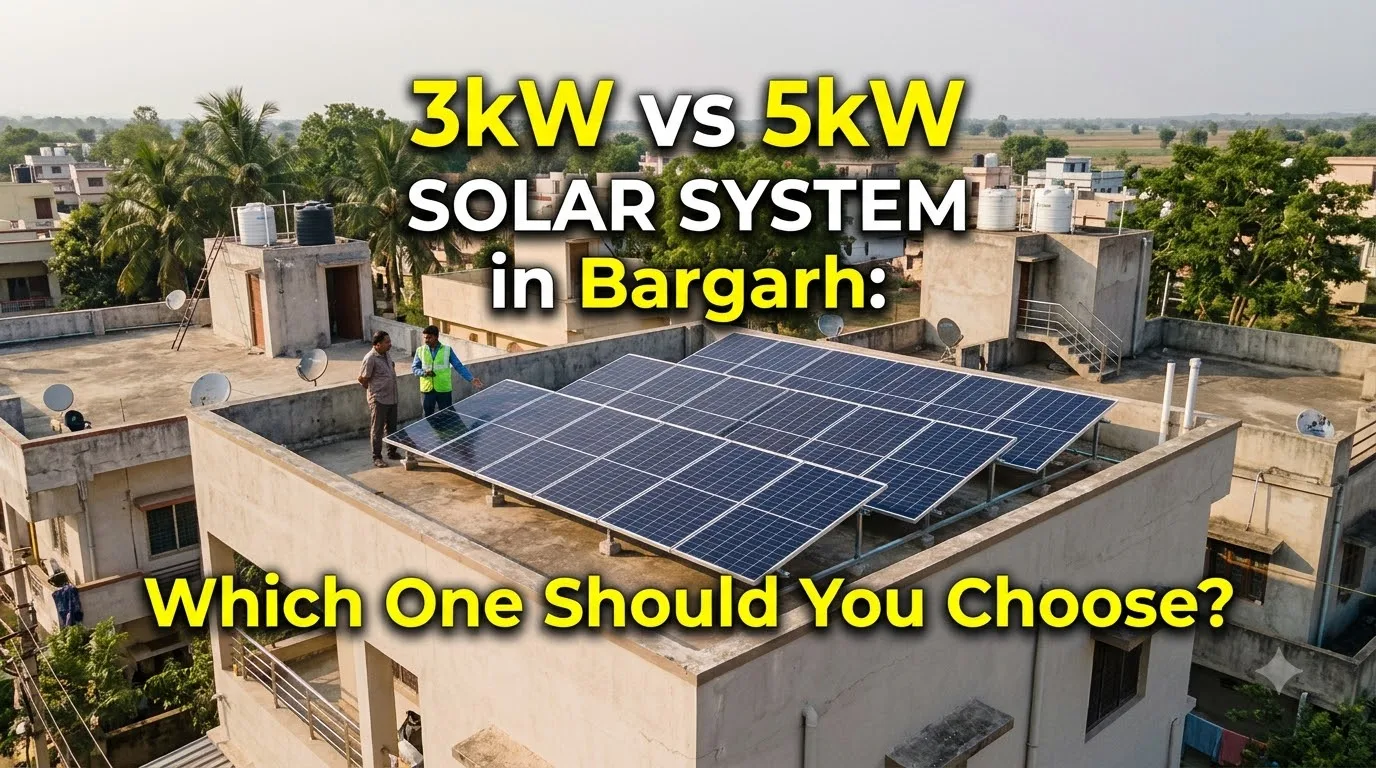
Choosing between a 3kW and a 5kW solar system is the most common decision for homes in Bargarh. The right size depends on your electricity use, your roof space and your budget — not on what sounds bigger.
Key Takeaways
- Choose a system by your electricity units, not by the size that sounds impressive: 3 kW suits roughly 250–400 units a month, 5 kW suits roughly 500+ units.
- A 3 kW system needs about 300 sq ft of roof and a 5 kW system about 500 sq ft.
- The central subsidy is capped at ₹78,000 from 3 kW onwards, so 3 kW usually gives the best subsidy-to-cost ratio.
- Bigger is better only if you actually consume the power or want to export more under net-metering.
- Send us 6–12 months of bills and we will recommend the exact size.
3kW vs 5kW solar system at a glance
| Parameter | 3 kW system | 5 kW system |
|---|---|---|
| Approx. price before subsidy | ₹1.7 – ₹2.2 lakh | ₹2.8 – ₹3.6 lakh |
| Central subsidy (PM Surya Ghar) | Up to ₹78,000 | Up to ₹78,000 (cap) |
| Panels needed (540 Wp) | 6–7 panels | 10 panels |
| Shadow-free roof area | ≈ 300 sq ft | ≈ 500 sq ft |
| Daily generation | ≈ 12 units | ≈ 20 units |
| Monthly generation | ≈ 330–360 units | ≈ 550–600 units |
| Yearly generation | ≈ 4,000–4,300 units | ≈ 6,500–7,200 units |
| Suitable for | Family home, 1–2 ACs | Large home, 3+ ACs, small shop or clinic |
| Typical inverter | 3 kW single-phase | 5 kW single or three-phase |
| CO₂ avoided per year* | ≈ 3 tonnes | ≈ 5 tonnes |
*CO₂ saving is an estimate based on the average grid emission factor in India. Actual generation depends on sunlight, tilt, shadow and cleaning.
How to calculate the right solar size for your home
The most reliable method is to look at your electricity consumption in units (kWh), not in rupees. Here is the simple formula we use at Solar Harvest India:
- Find your average monthly units from the last 6–12 bills (include summer months when ACs run).
- Divide by 30 to get daily units. Example: 360 ÷ 30 = 12 units per day.
- Divide by 4 (average solar units per kW per day in our region). Example: 12 ÷ 4 = 3 kW.
- Add 10–15% room if you plan to add an AC, an electric vehicle or a water heater soon.
- Check your roof for the shadow-free area needed (about 100 sq ft per kW).
Who should choose a 3 kW solar system?
A 3 kW system is the most popular home size in Bargarh. It covers the needs of a typical family home with fans, lights, TV, refrigerator, a washing machine, a water pump and one or two air-conditioners used moderately. It fits on most flat roofs, needs less investment and fully uses the maximum central subsidy of ₹78,000.
- Monthly consumption of about 250–400 units
- Roof area of 300–400 sq ft available
- Budget-conscious family wanting the fastest payback
- Home with one or two ACs and no commercial load
Who should choose a 5 kW solar system?
A 5 kW system makes sense when your monthly consumption goes beyond 500 units or you run heavier loads. It is common among larger houses, homes with three or more ACs, doctors’ clinics, tuition centres, shops and small offices where most electricity is used in the daytime — exactly when solar produces power.
- Monthly consumption of 500–700 units
- Roof area of 500+ sq ft available
- Daytime electricity use, such as a shop, clinic or home office
- Plans to add an electric vehicle charger or more ACs
Can a 3 kW system run an AC? Can a 5 kW run everything?
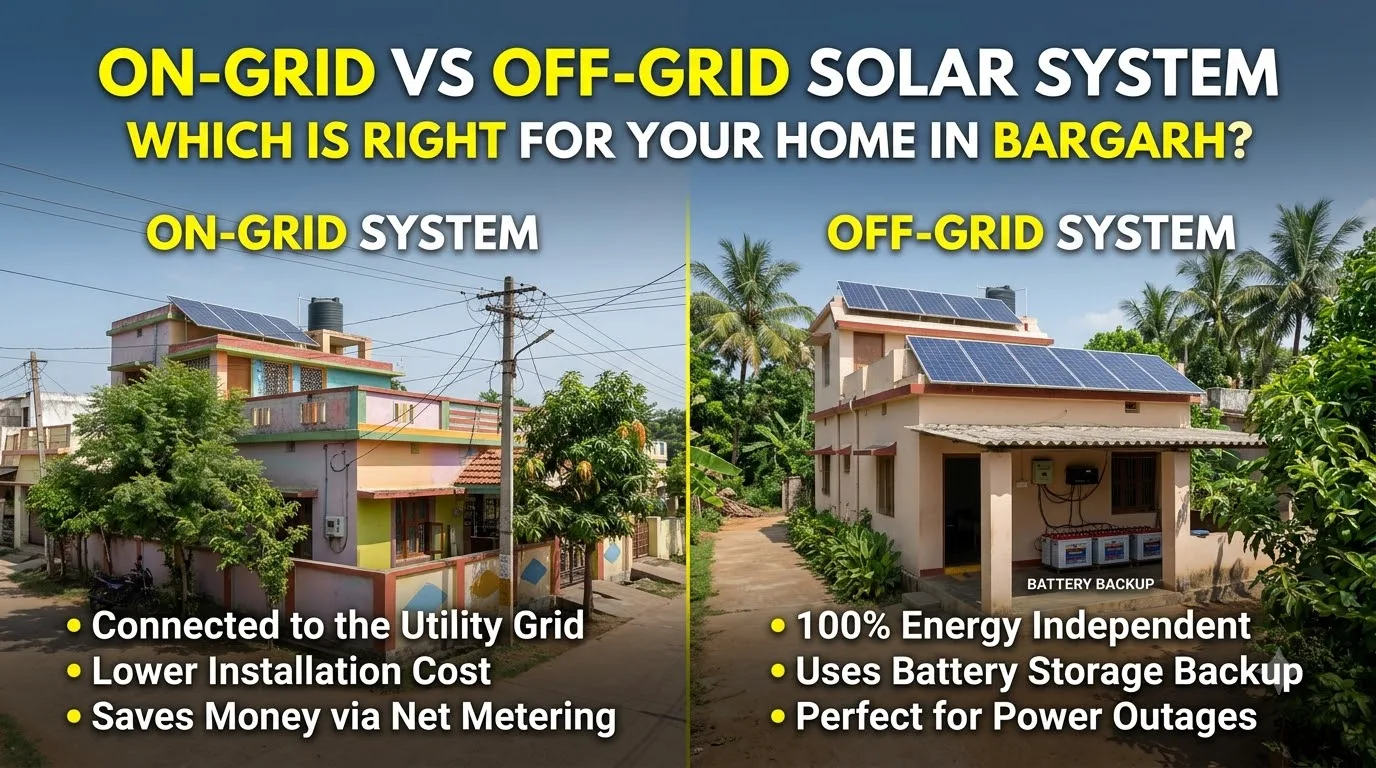
A 1.5-ton inverter AC uses about 1.2–1.5 kW when running. On a sunny day a 3 kW system can easily run one such AC along with other appliances; with two ACs together you may draw some power from the grid, which is perfectly normal for an on-grid system. A 5 kW system can comfortably run two to three ACs in the daytime. Remember that an on-grid system does not store energy, so it does not run your house at night — the grid, or a battery in a hybrid system, does that.
Net-metering: why a slightly larger system can still pay
With net-metering, extra units your system produces are exported to the grid and credited against what you import. If you are planning to increase your usage in the next few years, or if your roof can easily take a bigger plant, a 4 kW or 5 kW system may give better long-term savings. However, it is important to know that surplus units are valued at the rate set by the regulator, so oversizing far beyond your use does not give the same returns as using the power yourself.
Beyond 3 kW and 5 kW: other sizes to consider
Not every home needs exactly 3 or 5 kW. A 2 kW system suits smaller homes using 150–250 units and still gets ₹60,000 subsidy. A 4 kW system is a good middle path for homes using 400–500 units. Larger rooftops of 7–10 kW are usually for commercial use, institutions or farms, and are covered by our commercial and industrial solar power systems.
Expandability and future-proofing
If you are unsure, ask your installer to design the structure, cabling and inverter selection so that the plant can be expanded later. For example, a 3 kW plant with a 5 kW-capable inverter and extra structure space makes upgrading easier. Note that subsidy applies only to the capacity registered at the time of application, so plan the size carefully before you apply under PM Surya Ghar.
Mistakes to avoid while choosing the size
- Choosing by price per kW alone without checking quality
- Ignoring the shadow of water tanks, parapet walls or nearby buildings
- Selecting a size larger than your sanctioned load without applying for load enhancement
- Believing that a bigger system gives proportionally bigger subsidy
- Forgetting that on-grid systems shut down during a power cut
Next steps for homes in Bargarh and Sambalpur
Visit our page on 3kW & 5kW solar systems in Bargarh for service details, check the latest solar panel price in Bargarh, or explore solar company services in Sambalpur.
Our advice
Do not buy by size — buy by your bill. Send us your last 6 months of electricity bills and we will recommend the exact capacity. Our 3kW & 5kW solar system page has more detail.
Frequently Asked Questions
Yes, a 3 kW system usually handles a typical home with one or two ACs used moderately, along with regular appliances.
Often yes, if your inverter and roof allow it. Tell us in advance and we will design the system to be expandable.
A 3kW solar system in Bargarh is best for homes using about 250–400 units a month. A 5kW solar system in Bargarh suits 500+ units or daytime shop use.
No. It saves more only if you use the power or the extra units are credited favourably. Oversizing beyond your consumption has a longer payback.
With 540 Wp panels, about 6–7 panels make 3 kW and about 10 panels make 5 kW. Exact numbers depend on the module wattage chosen.
Yes, a home borewell or booster pump can run on rooftop solar during the day. For farm irrigation, a dedicated solar water pump may be more suitable.