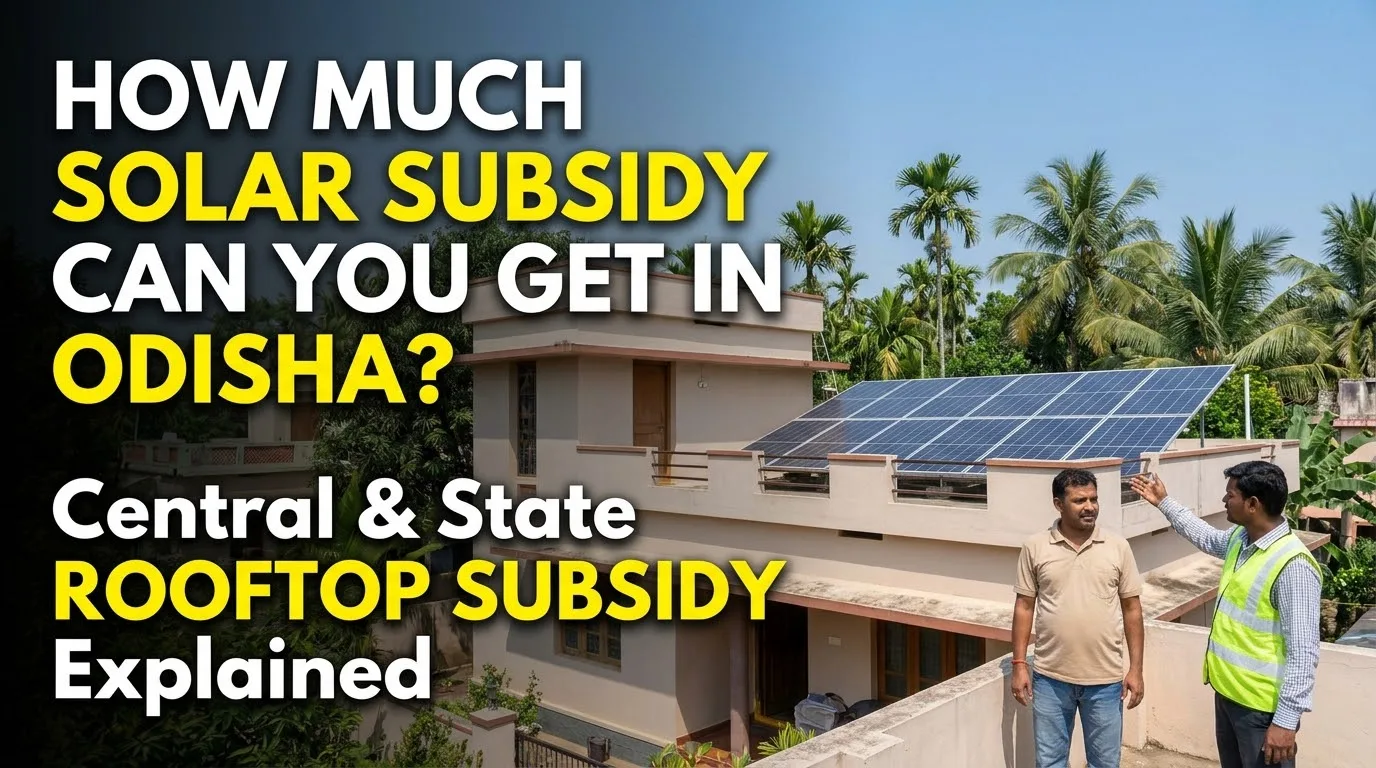
Solar has never been more affordable in Odisha, thanks to government support. Homeowners may benefit from a central subsidy under the PM Surya Ghar scheme, and a state subsidy may also be available. Here is how it works.
Key Takeaways
- The central PM Surya Ghar subsidy for homes is ₹30,000 per kW for 1–2 kW and ₹18,000 for the 3rd kW, up to a maximum of ₹78,000.
- Solar Harvest India shares a state subsidy of up to ₹60,000 for eligible customers, subject to state guidelines and terms.
- Subsidy is for grid-connected residential rooftop systems with eligible panels, registered through the national portal.
- Commercial and industrial users can benefit from other incentives such as accelerated depreciation, and farmers from solar pump schemes.
- Rules change — always confirm the latest status before you book.
Types of solar subsidy and incentives available in Odisha
Many people say “solar subsidy” as if it is one thing. In reality there are several layers of support for solar in Odisha, aimed at different users. Knowing which one applies to you helps you plan your investment correctly.
| User | Support type | What it means |
|---|---|---|
| Homes (residential) | Central CFA — PM Surya Ghar | Up to ₹78,000 for rooftop solar |
| Homes (residential) | State subsidy (as per guidelines) | Additional support; up to ₹60,000 shared by us for eligible customers* |
| Housing societies / RWAs | Central support for common facilities | Separate provisions as per scheme guidelines |
| Farmers | Solar pump schemes (e.g. PM-KUSUM) | Subsidised solar water pumps as per current norms |
| Commercial / industry | Accelerated depreciation and net-metering | Tax and bill benefits, no PM Surya Ghar subsidy |
*State subsidy details depend on current government guidelines, budget availability and terms and conditions. Always confirm the latest rules.
Central subsidy: PM Surya Ghar Muft Bijli Yojana
The Government of India launched PM Surya Ghar with the aim of lighting up one crore homes with rooftop solar. The subsidy is calculated as ₹30,000 per kW for the first 2 kW and ₹18,000 for the third kW, with a maximum of ₹78,000 for 3 kW or more. The subsidy is paid directly into the beneficiary’s bank account after the system is installed, inspected and commissioned. You can read the application steps in our guide on PM Surya Ghar eligibility, documents and how to apply.
State subsidy for rooftop solar in Odisha
Alongside the central scheme, the state government and its agencies promote renewable energy through the Odisha renewable energy policy and rooftop solar support. For eligible homes, a state subsidy can be added on top of the central subsidy. The exact amount, eligibility, and whether funds are available can change with each budget and notification, which is why we advise customers to verify the current status at the time of booking. Our team helps customers check and apply for the state benefit wherever it is available.
Worked examples: your cost after subsidy
These are examples only; your actual price depends on components and site conditions. For realistic price ranges see our solar panel price in Bargarh page.
| System | Approx. cost | Central subsidy | Cost after central subsidy |
|---|---|---|---|
| 2 kW | ₹1.35 lakh | ₹60,000 | ≈ ₹75,000 |
| 3 kW | ₹2.0 lakh | ₹78,000 | ≈ ₹1.22 lakh |
| 5 kW | ₹3.2 lakh | ₹78,000 | ≈ ₹2.42 lakh |
How the subsidy gets credited — the money trail
- You register and apply on the national portal and receive feasibility approval.
- You pay the vendor the system cost as per your agreement (the subsidy is not deducted upfront in the standard process).
- After installation and net-meter commissioning, the DISCOM inspects the system and issues a commissioning certificate.
- You upload the certificate, bank details and cancelled cheque on the portal.
- The central subsidy is credited to your account, typically within a few weeks after verification.
Because the subsidy arrives after commissioning, plan your cash flow. Some banks offer solar loans to bridge this gap.
Subsidy for farmers and village solar
Odisha’s farming heartland, including the Bargarh district known for its paddy fields and Hirakud canal irrigation, benefits from schemes that promote solar water pumps and solar-powered irrigation. Eligible farmers may get significant support on solar pumps under central and state programmes. Our solar water pump service can help you understand current options. Street lighting and public-use solar for panchayats may also be supported under various programmes — see our solar street light service.
Subsidy for commercial and industrial solar
Shops, hotels, rice mills, clinics and factories in Odisha are not covered by PM Surya Ghar, but they enjoy other strong benefits: a large reduction in daytime power bills, net-metering or open-access options, and tax benefits such as accelerated depreciation on solar assets as per prevailing income-tax rules. Speak to your tax advisor about the current rate. See our industrial solar power systems.
Tips to claim the maximum subsidy without trouble
- Check that your name is the same on your electricity bill, Aadhaar and bank account
- Use a registered vendor and DCR-compliant solar modules
- Choose the right system size — 3 kW usually maximises the central subsidy ratio
- Do not start installation before getting the required approval
- Keep copies of invoices, commissioning certificate and portal acknowledgement
- Follow up with your installer until the subsidy shows in your account
Get help from a local expert
We guide you from application to subsidy credit. See our solar subsidy assistance service or contact us.
Frequently Asked Questions
Where both schemes are available and you meet the conditions, you can benefit from both. We will confirm the current rules for you.
The PM Surya Ghar subsidy is for residential rooftop systems. Commercial and industrial users may benefit from other incentives such as depreciation benefits.
The solar subsidy in Bargarh and across Odisha for homes is up to ₹78,000 centrally, plus a possible state subsidy. The solar rooftop subsidy Bargarh residents claim is paid after commissioning.
In the standard process you pay the vendor the full system cost, and the central subsidy is credited to your bank account later after commissioning.
The central scheme is meant for grid-connected rooftop systems. Battery portions are generally not subsidised, so check the latest guidelines for your case.
No. It is for residential consumers. Shops and businesses can still save heavily and may use other incentives.