Before you buy solar panels in Bargarh, you must decide the type of system. The three options — on-grid, off-grid and hybrid — work very differently and cost very differently.
Key Takeaways
- On-grid solar is connected to the DISCOM grid, has no battery, costs the least and gives the fastest payback; it stops working during a grid outage.
- Off-grid solar uses batteries and works without the grid — ideal for farms and remote places — but costs more and needs battery replacement.
- Hybrid solar combines grid export with battery backup and is best for homes and businesses facing frequent power cuts.
- Only grid-connected rooftop systems installed through registered vendors qualify for the PM Surya Ghar subsidy.
- Pick your system type by your power-cut problem and your budget, not by what sounds most advanced.
How a solar system works: the basics in plain language
Solar panels are made of silicon cells that convert sunlight into direct-current (DC) electricity through the photovoltaic effect. Your home runs on alternating current (AC), so an inverter converts the DC power into AC. What happens next — whether the power goes to the grid, into a battery, or both — decides whether your system is on-grid, off-grid or hybrid.
Understanding this difference is important because it changes the price, the maintenance, the subsidy you can claim and what happens when the electricity goes off in your area of Bargarh.
On-grid solar system explained
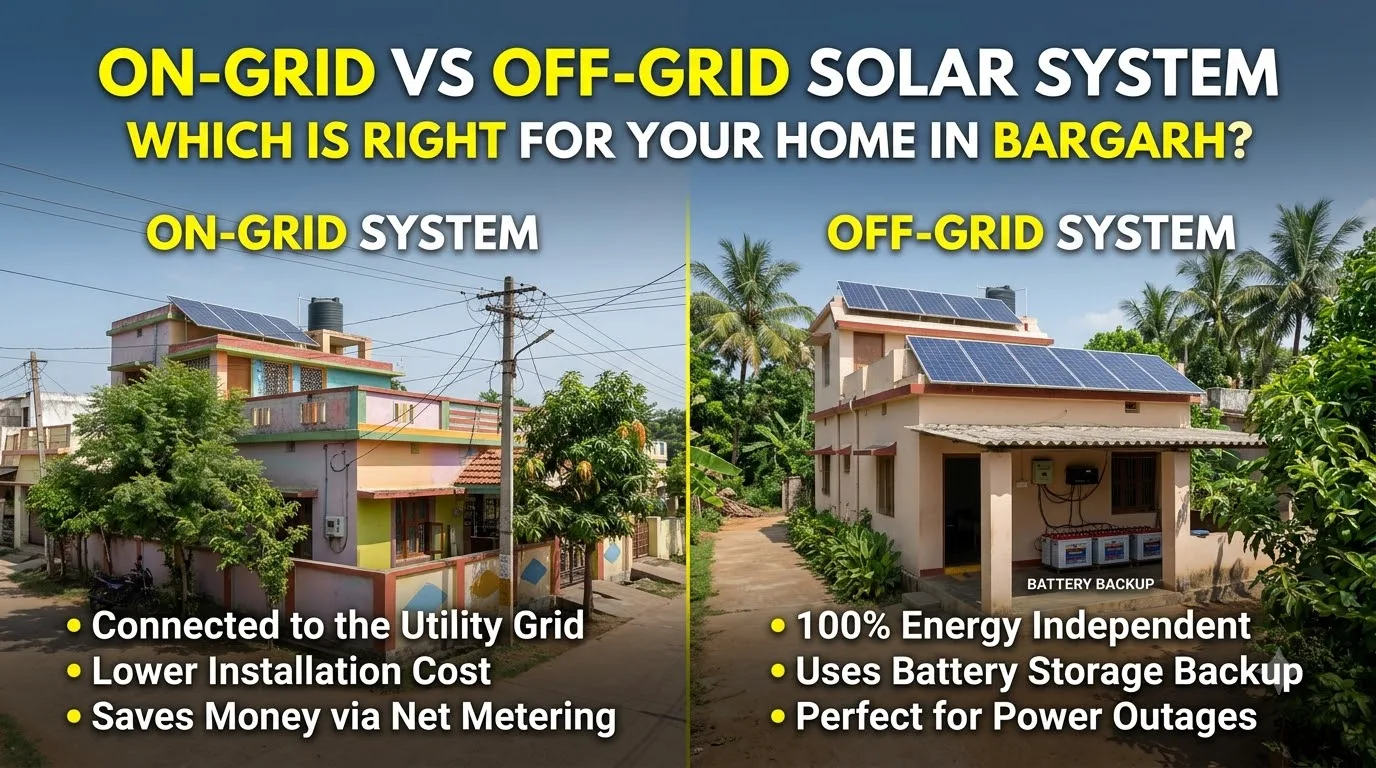
An on-grid (grid-tied) system is connected to the DISCOM network through a bi-directional net meter. During the day your solar power first runs your appliances. If you produce more than you use, the extra units flow into the grid and are credited to your account. At night or on cloudy days you take power from the grid as usual, and the credits are adjusted in your bill.
- No batteries — which keeps the installation cost and maintenance low.
- Highest return on investment — payback is typically 4–6 years after subsidy.
- Net-metering income — surplus units reduce your future bills.
- Subsidy eligible — rooftop on-grid systems qualify under PM Surya Ghar Muft Bijli Yojana.
- Limitation — it shuts down automatically when the grid fails (anti-islanding safety), so it will not give you backup in a power cut.
Off-grid solar system explained
An off-grid system is completely independent of the electricity grid. Solar panels charge a battery bank through a solar charge controller or off-grid inverter, and your home runs from the batteries. It must be sized to cover your loads at night and during cloudy days, which means larger battery banks and higher costs.
- Complete independence from the grid and from power cuts.
- Ideal for farm houses, borewells, remote sites, small shops in areas with no or poor grid supply.
- Higher cost because of battery capacity, usually lithium (LFP) or tubular lead-acid.
- Battery replacement every 5–10 years depending on type and usage.
- No net-metering income because there is no grid connection.
Hybrid solar system explained
A hybrid system is the “best of both worlds”. A hybrid inverter manages solar, battery and grid together. Your home runs on solar first, charges batteries with extra solar, exports the rest to the grid where allowed, and uses batteries during outages. It costs more than on-grid but gives you both savings and backup. See our solar hybrid system service for details.
On-grid vs off-grid vs hybrid: detailed comparison
| Feature | On-grid | Off-grid | Hybrid |
|---|---|---|---|
| Grid connection | Yes | No | Yes |
| Battery | No | Yes, essential | Yes, optional size |
| Works in power cut | No | Yes | Yes |
| Relative cost | Lowest | High | Highest |
| Payback period | Fastest (≈4–6 yrs) | Slow (batteries) | Medium |
| Net-metering | Yes | No | Yes |
| PM Surya Ghar subsidy | Yes (rooftop, residential) | Generally no | Depends on grid-connected capacity and scheme norms |
| Maintenance | Very low | Battery care needed | Battery + inverter care |
| Best for | Homes with stable supply | Farms, remote sites | Homes and businesses with frequent outages |
Battery technology: lead-acid vs lithium
If you choose an off-grid or hybrid system, the battery is the most important decision. Tubular lead-acid batteries are cheaper upfront, typically last 4–6 years and need regular water topping. Lithium iron phosphate (LiFePO4) batteries cost more but last 8–10+ years, are maintenance-free, lighter, and allow deeper discharge. For most homes, lithium works out better in the long run. Always size batteries based on the load you want to back up, not on the biggest battery available.
Quick rules for choosing your system type
Use these simple rules of thumb:
- Rare power cuts, want maximum savings → on-grid.
- Frequent or long power cuts, want savings plus backup → hybrid.
- Farm, borewell or place with no grid → off-grid, or a dedicated solar water pump.
- Business that cannot stop for even an hour → hybrid with adequate battery or a combination with a generator.
A popular choice for homes in Bargarh is on-grid today with the structure and wiring planned so that a battery can be added later if outages become a problem.
Cost and subsidy: what to expect
An on-grid system is the most affordable, and a 3 kW rooftop plant is typically priced around ₹1.7–2.2 lakh before subsidy; see our solar panel price guide for Bargarh. Adding batteries can add roughly ₹80,000 to ₹2 lakh or more. The central subsidy of up to ₹78,000 applies to eligible grid-connected residential rooftop systems, so most families choose on-grid to capture the maximum subsidy.
Common myths about solar systems
- Myth: “Solar will run my house during a power cut.” Truth: only if it has batteries (hybrid or off-grid).
- Myth: “Solar does not work on cloudy days.” Truth: output falls but does not stop; yearly generation averages out.
- Myth: “Solar needs a lot of maintenance.” Truth: on-grid systems need only periodic cleaning and a yearly check.
- Myth: “Batteries last forever.” Truth: they are a consumable with a defined life.
Which should you choose in Bargarh?
If your area has mostly reliable power, an on-grid system gives the fastest payback. If you face frequent outages or run a business that cannot stop, choose hybrid. Choose off-grid for farms, remote sites and areas without a grid connection.
Explore our on-grid and off-grid solar system page or our hybrid system service.
Frequently Asked Questions
No. On-grid inverters switch off during a grid outage for safety. If you need backup, choose a hybrid system with batteries.
On-grid is the cheapest because it has no batteries. It also gives the best return on investment.
Choose an on grid solar system in Bargarh for the lowest cost and best savings. Choose an off grid solar system in Bargarh for farms or places without grid power. Hybrid is best for backup.
Often yes. If you plan this from the start, the installer can choose a hybrid-ready inverter and keep space for the battery.
No. Net meters are required only for grid-connected systems.
For most urban homes with fairly stable supply, on-grid is best. For farms and outage-prone areas, hybrid or off-grid works better. A site visit will confirm the right choice.