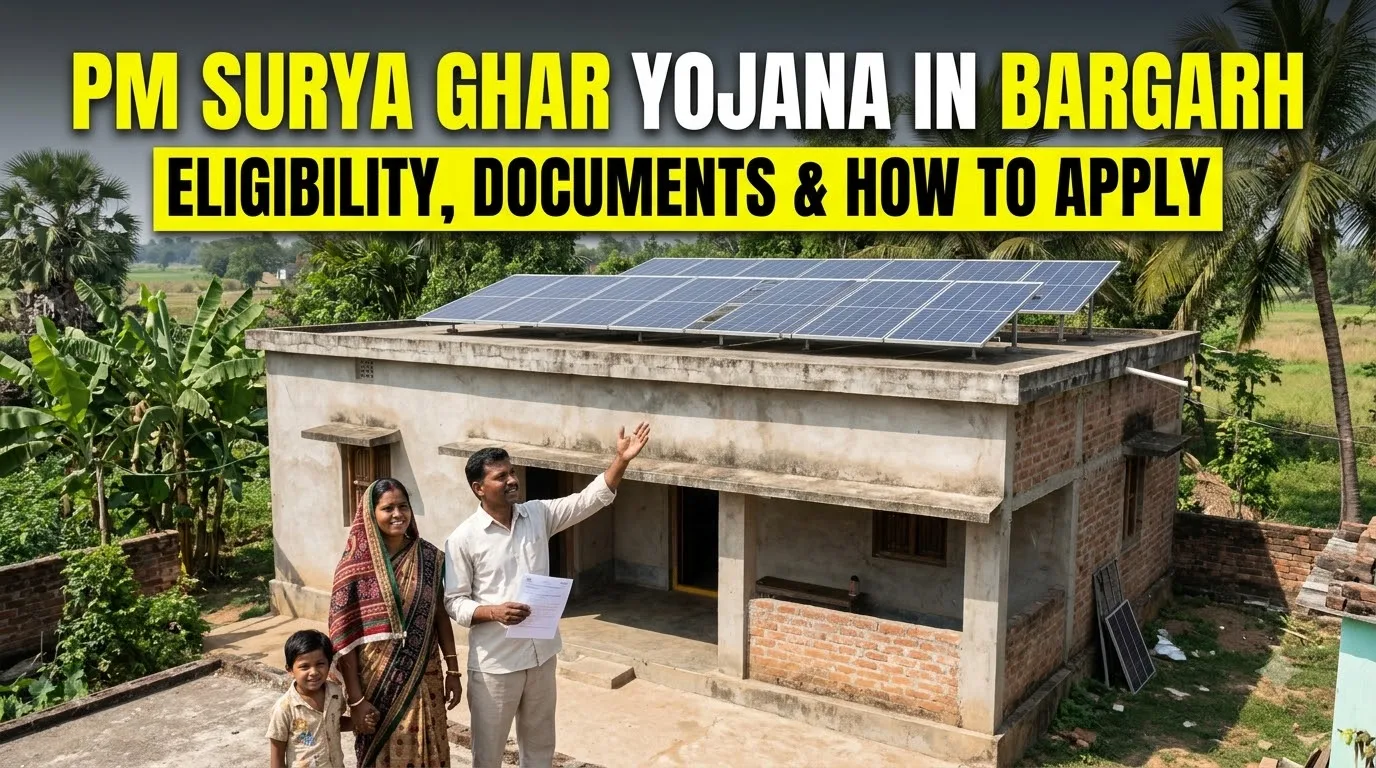
The PM Surya Ghar Muft Bijli Yojana is a Government of India scheme that helps households install rooftop solar with a central subsidy and enjoy up to 300 units of free electricity a month. If you live in Bargarh, here is exactly how to apply.
Key Takeaways
- PM Surya Ghar Muft Bijli Yojana offers central subsidy of ₹30,000 per kW for the first 2 kW and ₹18,000 for the 3rd kW — a maximum of ₹78,000 per home.
- Eligible households can get up to 300 units of free electricity a month by generating their own solar power.
- You need a residential roof, a valid electricity connection, an Aadhaar-linked bank account and domestically manufactured (DCR) solar modules.
- Application is through the national portal; the subsidy is credited to your bank after the DISCOM inspects and commissions the system.
- A local installer in Bargarh can manage registration, documentation and follow-up for you.
Solar subsidy in Bargarh: the quick answer
The solar subsidy in Bargarh for homes comes from the central PM Surya Ghar Yojana: ₹30,000 per kW for the first 2 kW and ₹18,000 for the third kW — up to ₹78,000 for a 3 kW system or larger. You register on the national portal, install through a registered vendor with DCR panels, complete net-metering, and the subsidy is credited to your bank account after inspection. A state subsidy may also be available as per current guidelines.
If you are searching for PM Surya Ghar Yojana Bargarh details, the sections below cover eligibility, documents, the step-by-step process, timelines and common mistakes. You can also see our page on PM Surya Ghar subsidy in Bargarh.
What is the PM Surya Ghar Muft Bijli Yojana?
The PM Surya Ghar Muft Bijli Yojana is a Government of India scheme announced in early 2024 with the aim of installing rooftop solar in one crore households. It supports families by giving a direct central financial assistance (CFA) on rooftop solar and promotes use of clean electricity. The scheme is meant for residential consumers, so shops, factories and offices are not covered under this particular subsidy.
For people in Bargarh and across Odisha the scheme is especially useful because electricity bills have been rising while sunshine is plentiful for most of the year. By generating your own power on the terrace, you can bring your electricity bill close to zero and may even earn from exporting extra units to the grid through net-metering.
Subsidy slab: how much will you actually get?
In simple terms, the government supports about ₹30,000 for every kW up to 2 kW, then ₹18,000 for the third kW, and stops at ₹78,000. Installing a 5 kW system will therefore not increase the central subsidy beyond ₹78,000, but it will give you more generation. Please also confirm any state-level subsidy that may be available at the time you apply — rules and amounts can change.
| System capacity | Central subsidy | Who it suits | Typical monthly use |
|---|---|---|---|
| 1 kW | ₹30,000 | Small homes, 1–2 rooms | Up to ~120 units |
| 2 kW | ₹60,000 | Medium homes | ~120–250 units |
| 3 kW and above | ₹78,000 (maximum) | Most family homes | ~250–400+ units |
Eligibility criteria in detail
- Residential use only — the electricity connection should be a domestic (household) connection.
- Own roof — you should have a roof that you are entitled to use and that receives good sunlight. Flats can apply through the resident association where permitted.
- Valid connection — an active electricity consumer number from your DISCOM. In Bargarh and Sambalpur this is usually TPWODL, the distribution company serving Western Odisha.
- No earlier solar subsidy — you must not have taken a central subsidy for solar on the same connection before.
- Bank account — a bank account in the applicant’s name so that the subsidy can be credited directly.
- DCR modules — solar panels with domestic content as required by the scheme, installed by a registered vendor.
Documents required checklist
- Latest electricity bill (shows consumer number and sanctioned load)
- Aadhaar card of the applicant
- Passbook or cancelled cheque with IFSC code
- Active mobile number linked to the electricity connection
- Email ID for portal registration
- Passport-size photo and, if needed, proof of roof ownership or consent
- Signed consent or no-objection from co-owners, where the house is jointly owned
Tip: make sure the mobile number on your electricity connection is active and that your name matches across the bill, Aadhaar and bank account. Mismatched names are the most common reason for delay.
Step-by-step application process
- Register on the national portal by selecting your state (Odisha), your DISCOM and entering your consumer number and mobile number.
- Log in and apply for rooftop solar with your details.
- Wait for feasibility approval from the DISCOM for your connection.
- Select a registered vendor — such as Solar Harvest India — and sign the installation agreement.
- Installation of panels, inverter and structure by the vendor.
- Submit plant details on the portal and apply for net-metering.
- DISCOM inspection and bi-directional meter installation, followed by commissioning.
- Upload bank details and cancelled cheque and receive the subsidy in your account after verification.
How long does it take?
From registration to subsidy credit, the whole process can take roughly 4 to 8 weeks for a typical home, though timing depends on DISCOM approvals and inspection schedules. Physical installation of the system itself usually takes only a few days. A vendor who coordinates with the DISCOM regularly can help avoid unnecessary delays.
Free electricity: how the “300 units” benefit works
The scheme encourages households to generate enough solar power to cover up to about 300 units of monthly consumption. A 3 kW system generates around 330–360 units a month, so a family using 300 units can offset nearly all its usage. Extra units are exported to the grid and credited against your next bill under net-metering. This does not mean the DISCOM gives you free power; it means your own solar plant supplies the electricity and your bill falls drastically.
Common reasons for delay and how to avoid them
- Name mismatch between electricity bill, Aadhaar and bank account
- Inactive mobile number linked to the connection
- Installing non-DCR panels or using an unregistered vendor
- Shadow-affected roof leading to poor feasibility
- Applying for a system size larger than the sanctioned load without load enhancement
- Not following up after installation for inspection and commissioning
PM Surya Ghar for Bargarh, Sambalpur and the rest of Odisha
The central subsidy is the same across Odisha. What differs is the local process — which DISCOM office handles your inspection, how fast approvals are, and which vendors are registered nearby. A local team that works with the Western Odisha DISCOM every week knows these details well. See our dedicated page on PM Surya Ghar Yojana and subsidy in Bargarh and our main PM Surya Ghar Yojana page for subsidy slabs and the application form.
Let Solar Harvest India handle the paperwork
Our Bargarh team does the eligibility check, portal registration, documentation, DISCOM coordination and subsidy follow-up. You only need to share your documents. Talk to our subsidy desk today.
Frequently Asked Questions
After your system is commissioned and inspected, the subsidy is normally credited to your bank account within about a month. Exact timing depends on DISCOM inspection.
Yes, you can apply on the official portal yourself, but most families prefer a local solar company to manage the technical and paperwork steps.
PM Surya Ghar Yojana Bargarh applicants get a central subsidy up to ₹78,000. The PM Surya Ghar subsidy Bargarh households receive is credited to the bank account after commissioning.
For the solar rooftop subsidy Bargarh process: register on the portal, get DISCOM approval, install through a registered vendor, complete net-metering and claim the subsidy.
The scheme is intended for the owner of the roof with a household electricity connection. A tenant would normally need the owner’s consent and the connection must be eligible. Check with our team for your case.
Individual flat owners usually cannot install on a shared roof alone. Resident welfare associations and group housing societies may apply for common facilities under separate provisions of the scheme.
Banks have been offering loans for rooftop solar for eligible households under the scheme. Terms change, so please confirm the current interest rate and documents with the bank.
A free site survey will show the shadow-free area. Small shadows can often be avoided by raising the structure or shifting panels, and we will tell you honestly if a roof is not suitable.